

Why SEO Matters
SEO is one of the most powerful marketing channels available to businesses today.
Why? Because it works.
Time and time again, it tops the charts for return on investment.
Research from First Page Sage suggests SEO delivers an average ROI of 748% for B2B businesses and 721% for B2C.
Many businesses quite literally owe their success to search engines. Their leads come from Google. Their enquiries come from Google. Their revenue is tied to being found online.
Take that away, and things get uncomfortable very quickly.
So yes, SEO matters.
A lot.
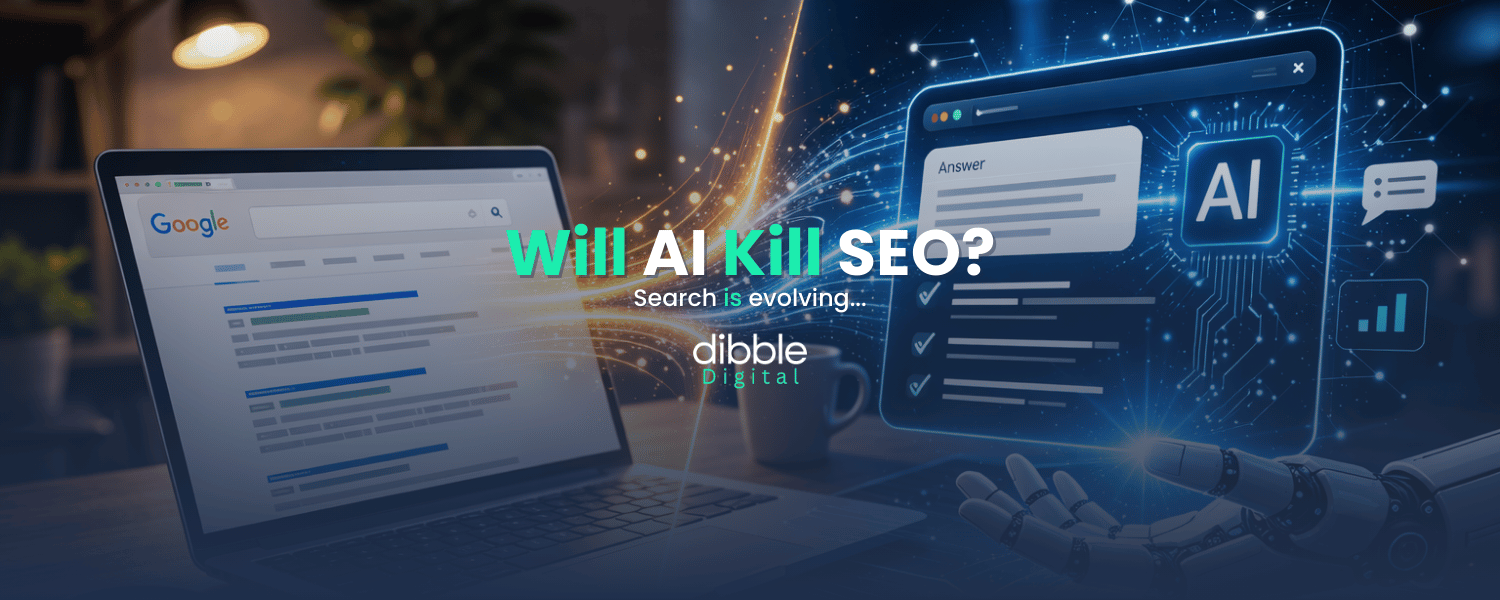
So when there is chatter in the digital marketing community asking “Will AI kill SEO?” There are a lot of people who are quite rightly concerned.
Let’s be honest. Every few years something new arrives and the marketing world declares the old way dead.
Social media was going to kill websites.
Voice search was going to kill typing.
Now AI is apparently coming for SEO.
So, will AI kill SEO?
Short answer, no.
Longer answer, AI is changing SEO, sharpening it, and moving the goalposts for optimisation.
But kill it? Not a chance.
Let’s zoom out and look at what is actually happening.
Why SEO Exists In The First Place
At its simplest, SEO is the pursuit of better visibility online by influencing search engines to display your website more prominently.
To understand whether AI can kill SEO, we need to understand what search engines actually do.
Let’s start with the big one: Google.
Google’s mission statement is:
“To organise the world’s information and make it universally accessible and useful.”
That is the job. Take the chaos of the internet and organise it in a way that helps people find what they need.
Search engines do this using algorithms. Ever-changing formulas made up of hundreds of ranking factors that decide which content deserves to be shown first.
If you show up first, or near the top:
-
You earn attention
-
Attention turns into traffic
-
Traffic turns into enquiries, sales, bookings and revenue
Visibility equals opportunity.
SEO is about understanding how that system works and aligning your website with what the algorithm rewards.
Strip it back and you could simplify the role of an SEO agency down to two slightly cheeky words:
Algorithm manipulation.
That is SEO. Influencing search algorithms so your content is surfaced.
How Do Search Engines Actually Work?
Search engines crawl the web, index pages, then use algorithms to determine:
-
Relevance
-
Authority
-
Trust
-
User experience
They analyse links, content, page structure, user behaviour, technical performance and much more.
SEO professionals study those signals and adjust accordingly. Better content. Better structure. Stronger authority.
It can feel like a black box, but in reality, it is just aligning with how information is organised.
How AI Changes SEO
Now let’s talk about AI.
Tools like ChatGPT, Gemini and Perplexity are attempting to do something very similar to search engines.
AI models review internet content.
They learn patterns.
They evaluate context.
They predict the most useful response.
That sounds suspiciously like a search engine.
Which leads to the obvious question.
Is AI The New Search Engine?
In many cases, yes.
AI is organising information and helping users find answers, but the difference is the format.
Instead of ten blue links, users receive a direct answer.
Instead of clicking through five websites to research something, users get one summarised response.
Under the bonnet, though, AI still relies on algorithms. Extremely advanced ones, but algorithms nonetheless.
They analyse language, intent and context at a level traditional search engines have been building towards for years.
You could think of AI as search’s smarter, more sophisticated older brother.
The goal remains the same: organise information, present the best answer.
What Is Generative Engine Optimisation (GEO)?
You may have heard a few new acronyms floating around:
-
Generative Engine Optimisation, or GEO
-
AI Optimisation, AIO
-
Answer Engine Optimisation, AEO
-
Large Language Model Optimisation, LLMO
Different names. Same core objective.
GEO (the most dominant name for SEO in the new AI world) is essentially SEO adapted for AI-driven platforms.
Instead of focusing purely on ranking position one in Google, businesses now need to think about:
-
Is your brand being cited in AI answers?
-
Does AI understand what you want to be known for?
-
Are you showing up for broader topics, not just isolated keywords?
-
Are you seen as a trusted authority?
There are some extra factors to consider, but the game is familiar.
There is an algorithm.
There is commercial intent.
There is competition for visibility.
Where visibility leads, marketing follows.
So What Happens To SEO?
If SEO is the act of influencing an algorithm so your content is shown first, then the only thing that has changed is the type of algorithm.
SEO will not die, but it is evolving.
The tactics may require tweaks. Authority signals may matter more. How other people talk about you will become increasingly important. Spammy, keyword-stuffed pages and bad user experience will die faster than ever before.
Happy days, right?
Because that means quality wins.
Will AI Replace Google?
Unlikely.
Google is already integrating AI directly into search results through AI Overviews and enhanced summaries.
This is not Google versus AI.
It is Google becoming AI-powered, with new competitors coming into the fray to challenge their dominance.
Search is evolving, but it’s not going anywhere.
Will AI Kill SEO?
Let’s answer it clearly.
No.
SEO exists because algorithms control visibility.
AI also runs on algorithms.
As long as algorithms decide who gets attention, businesses will want to influence them.
As long as attention can turn into revenue, optimisation will exist.
The only scenario where SEO truly dies is one where AI no longer relies on the internet to learn, reference or validate information.
If machines somehow develop a more efficient way to understanding the world’s knowledge without the internet, then maybe optimising for internet searches will become irrelevant.
We are nowhere near that.
Right now, AI systems are trained on the internet, moreover, they depend on it.
Which means your website still matters, very much so, perhaps more than ever.
The Future Of SEO In An AI World
In the most simplest of terms, SEO and AI optimisation share the same goal: be the source that the algorithm chooses.
Whether that algorithm produces a ranked list of links or a single summarised answer makes little difference. If your business is not part of the information pool being selected, you are invisible.
The name of the process or job title might change. The fundamentals will not.
SEO. GEO. EIEIO. Call it what you like.
As long as there is an information superhighway and algorithms organising it, there will be people working out how to manipulate them.
Final Verdict
AI will not kill SEO, it will refine it. It will raise the bar and it will reward businesses that show up online with intent, energy, and determination.
Long live the information superhighway.
And long live SEO.
Work With Dibble
Do you need some help getting your business found online? Then why not request some keyword research to see what people are searching in your industry, and learn why (and how) you should be showing up (yes keyword research still matters).